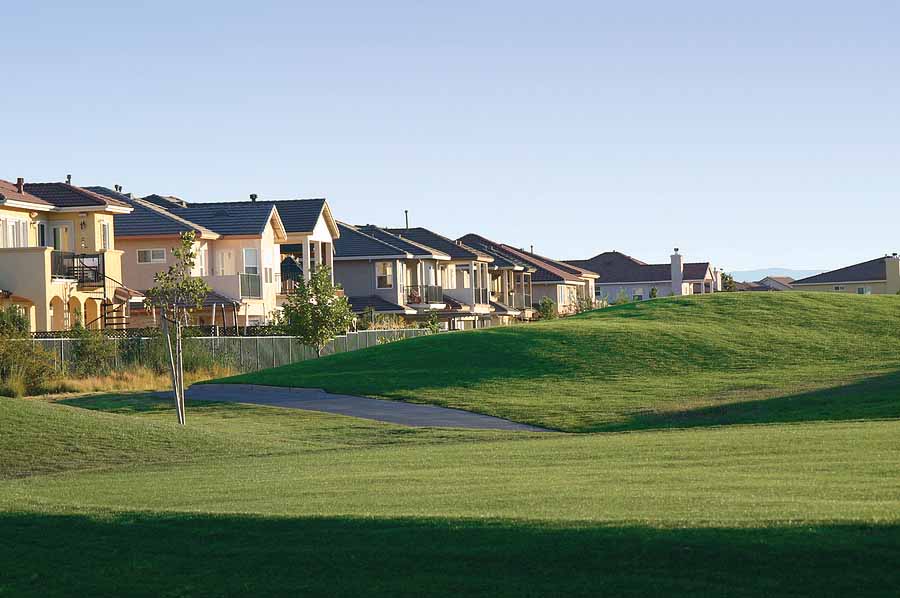
Congratulations! You are ready for a house – your retreat – on the golf course! While a realtor may assert “location, location, location,” your lawyer should emphasize, “contract, contract, contract.” Living on a course certainly has its advantages, but there are a few factors to consider before buying your golf course dream home. Consider HOAs, location hazards, and the construction process.
Many housing communities on a golf course are subject to a homeowner’s/community association (HOA). You will be required to abide by the HOA’s rules and regulations; these covenants are a contract. The rules and regulations may control the use of your home and its outside appearance as well as place certain restrictions or limitations on common land, community property, or greenbelts that may be adjacent to your home. Furthermore, some golf courses are a community association unto themselves, with rules of governance affecting the use of this “sacred ground.” It is not uncommon for a golf course to be controlled by two separate HOAs, one for the course and one for the homes.
Both HOAs may require dues or assessments for property care and usage. As a member under contract, you have the right to review both the golf course and homeowner HOAs’ financial records. Do this! They often provide insight as to HOA management practices. If the golf course is having financial problems, you may end up with the course closing and thereafter observing a fairway full of weeds, errant trees, and debris.
Golf courses can create hazards for homeowners – think of a golf ball planting itself into your siding, striking and damaging your roofing tiles, or occasionally shattering those gorgeous windows overlooking the course. Some golf courses may offer a group insurance policy to provide some compensation for damages; however, many dispute liability, leaving you liable for repairs. In addition, the course seldom assumes responsibility for injuries sustained by the homeowner.
In developing a contract with your architect, you must ensure you are compliant with the contracts that exist between the golf course and your homeowners’ associations. You should also consider construction materials carefully. Stucco can be beautiful; however, on a golf course it can frequently look like acne due to errant balls. Careful placement of windows is also critical.
If you have a choice of locations, try to project where your land might be in relationship to the tee-box, bunkers and/or green. Perhaps the most dangerous position to be is in the vicinity of the tee-box since all golfers are not created equal. Bunkers help trap the ball as it continues its wayward journey toward the green, but homes near the green might suffer the consequences of a ball that is hit too long in approaching the pin.
When considering a contractor, make sure they have experience with constructing homes around golf courses. During construction, engage an independent structural engineer or architect to oversee the job being performed by the general contractor. Insist upon weekly inspections and financial reviews to ensure the builder is compliant with your contract and time-lines. Remain vigilant to mechanic liens, construction material shortages and unauthorized change orders. If possible, obtain a performance bond on the builder to protect you financially if he fails to construct the home properly. It would also be prudent to obtain a builder’s warranty to protect your house from soil shifting, a common occurrence in Colorado.
Make sure you have protective language in your contract. For example, there can be unique drainage problems with living on a golf course; it’s not unusual for the course itself to become a menace as water drains off the course and toward your foundation. The foundation requires special construction techniques to avoid problems with expansive soil, which is common in Colorado. Proper landscaping (e.g., trees, shrubs) is important to protect the house while also allowing you to enjoy the view from inside. Also consider the movement of your motor vehicles on and off of the property and vehicle placement in relationship to the fairway.
Glenn Hagen, Attorney at Law.